

Most of us have grown up in a world that rewards improvement. On things like Better grades, better performance reviews, better numbers than last year. We are trained from early on to measure progress by asking one question. Are we doing better than before?
And honestly, I think that is a reasonable way to live. When it comes to personal growth, professional development or building a career, the improvement mindset works. Pushing for better is how people move forward.
But the planet is not that kind of system. It has boundaries. Real ones. And once you cross them, you do not get to go back and try a different approach.
This is the problem at the heart of how sustainability is practiced today. Most organizations, governments, and individuals are still asking the improvement question. Are we doing better than last year? Are we ahead of our competitors? Are our numbers moving in the right direction?
Seriously, those are not bad questions, but they are the wrong ones, especially considering the state of the planet. And the gap between asking the right question and the wrong one is exactly where the planet is being lost.
There is a concept called absolute sustainability. It does not measure how you compare to others or to your own past. It asks whether your total impacts fit within what the planet can actually handle. That is a fundamentally different question.
And that one shift changes everything.
Why measuring improvement is not the same as measuring sustainability
A company can improve its relative performance every single year and still make things worse in absolute terms. A factory cuts emissions per product every year, but total emissions rise because it keeps producing more, ending up higher than its carbon budget. The relative story looks like progress. The absolute story does not.
This is where absolute sustainability becomes important because it connects performance with planetary boundaries. These boundaries define the relatively stable conditions, what scientists call a Holocene-like state, that allowed human civilization to develop in the first place. And we are pushing ourselves out of that stability. In fact, Seven of the nine planetary boundaries that define a safe operating space for humanity have already been crossed. Climate change. Biosphere integrity. Land system change. Freshwater. Biogeochemical flows. Novel entities. Ocean acidification.
The Brundtland Report, back in 1987, already planted the seed of this idea. It said sustainability implies limits, shaped by the biosphere’s ability to absorb impacts. It framed those limits as an intergenerational obligation. The choices we make today constrain what future generations inherit. What has changed is that science has since made those limits explicit, measurable and in several cases already exceeded. The ethical argument has become a quantifiable one.
This is where this conversation starts to matter for your organization directly. The question is no longer whether we are improving, but what our allocated share of the remaining safe operating space actually is, and whether our total impacts stay within it. Most organizations have never attempted to answer that. But without that answer, every sustainability claim is incomplete.
Why efficiency alone is not enough
There is a pattern that shows up again and again in the data. Efficiency improves. Emissions per unit fall. The technology gets better. And yet total pressure on the planet keeps rising.
This is called the rebound effect. When you make something more efficient you lower its effective cost. Lower cost usually means more use. More use means more total impact. The efficiency gain gets eaten by the scale of growth.
Think about how fuel-efficient cars got better over the past 30 years. Unit emissions fell significantly. But the number of cars on the road kept growing. Total transport emissions went up. The efficiency was real. The outcome was still overshoot.
The same logic applies across food systems, water use and material consumption. Recycling rates improving while total virgin material extraction keeps rising is the same pattern. Water efficiency improving while total freshwater withdrawals exceed what watersheds can safely replenish is the same pattern.
In every case, the metric improves and the system still breaks.
This is why absolute sustainability insists on caps and budgets alongside efficiency. Carbon budgets are the clearest example. The remaining carbon budget for limiting warming to 1.5 degrees is a finite number. It does not care how efficient your processes are. It only cares about cumulative total emissions. Once the budget is gone, it is gone.
How does this influence your sustainability strategy?
You do not just set intensity targets. You set absolute limits. You ask what your emissions need to be within a defined period of time in total, and you build your growth and decarbonisation plans around that constraint. If those two things do not align, the strategy is not sustainable in absolute terms, no matter how efficient it looks.
The UK already considers this. Carbon budgets there are legally binding, set years in advance and cover five-year periods. That is not an improvement target. That is a constraint. Oslo goes further, embedding annual emissions limits directly into city governance and budget planning the same way a finance department manages spending. The EU Emissions Trading System puts a cap on total emissions across sectors and tightens it over time.
They are examples of changing the question from how do we improve to how do we stay within the planetary boundary.
What it actually means to operate within planetary limits
Absolute sustainability is not a new reporting standard. It is a reference framework. A way of measuring impact not against peers or against past performance but against external thresholds or the carrying capacities of the planet.
Frameworks that take this seriously share three features. A ceiling, which is the biophysical limit of what the Earth can absorb. A floor, which is the minimum standard of human dignity and wellbeing that any sustainable system must protect. And rules for fair allocation, because limits only become real when you decide who gets what portion of the remaining safe operating space and make that logic.
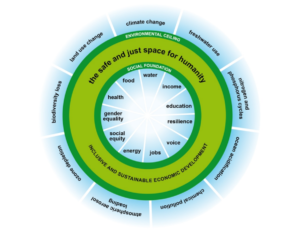
The doughnut model. Source: Kate Raworth, A Safe and Just Space for Humanity, Oxfam 2012.
The doughnut model captures this visually. Below the social foundation is deprivation, and above the ecological ceiling is overshoot. The goal is to stay in the space between them, not to optimize within overshoot.
In practice, this forces a different kind of planning conversation. You map your full impact across the value chain, not just what happens inside your operations but upstream and downstream as well. You translate your sector-level limits into company-level budgets. You evaluate, explicitly, how much you are allowed to emit, extract or disturb, and you design your operations to stay inside that.
Justice is also part of the conversation, especially when it comes to defining country limits and sector-level limits. Safe and just Earth system boundaries work makes clear that reducing overshoot is not only an ecological obligation but a justice one. The communities least responsible for overshoot are usually the first to experience its consequences, and in many cases should have more flexibility within their budgets, especially since many of these communities are still developing and have every right to pursue growth. Just transition means ensuring that the countries with the greatest historical contribution to overshoot are held responsible and accountable for carrying a larger share of the burden.
Is it possible to remain within the planet’s boundaries?
Stratospheric ozone is a perfect answer. It is one of the few cases where humanity recognized a boundary, agreed on enforceable limits and actually reversed the damage. It shows that this kind of coordination is possible. It also shows that it only works when the limits are clear and the rules are binding.
How Absolute Sustainability Will Impact ESG
ESG frameworks and sustainability disclosure regimes are built for a specific purpose. They help investors compare companies. They are good at telling you whether Company A performs better than Company B on a range of indicators.
What they are not designed to do is tell you whether either company is operating within absolute ecological limits. And this needs to change.
ESG metrics should be linked to absolute thresholds such as carbon budgets, water budgets and material use budgets.
Science-based targets are the most serious attempt to do this at scale. Aligning corporate emissions pathways with what the climate system can actually absorb is absolute sustainability logic applied at the organizational level.
But even here, the details matter. Targets only mean something if they are truly absolute, if they cover the full value chain, and if they rely on real reductions rather than shifting impacts elsewhere or pushing them into the future.
And this is where the word “zero” becomes important. We have obsessed over the past decade on making sure that our target is “net zero” and not “zero emissions”. But in absolute sustainability, “zero” is the master. “Zero” as in “zero overshoot”.
The limits of absolute sustainability itself
Absolute sustainability is a powerful framework. But it is honest to acknowledge where it struggles.
The first challenge is downscaling. Planetary boundaries are defined at a global level. Translating them into what a single city, company or product requires allocation decisions that involve contested ethical choices. Who gets what share of the remaining safe space is not only a scientific question. It is a political and moral one. And there is no universally agreed answer yet.
The third challenge is growth. Absolute sustainability raises open and genuinely difficult questions about whether economic growth and staying within planetary limits can coexist. Can green growth deliver the decoupling that absolute sustainability requires? Or do certain sectors need to contract rather than grow? These are not questions with easy answers, and there is no global, regional or even local consensus on how to resolve them. That tension is real and the framework does not resolve it. It makes it visible.
And finally there is the governance gap. Allocation, measurement and enforcement are the operational frontier of absolute sustainability. The tools for some of these, like carbon budgets and science-based targets, are developing fast. For others, like biodiversity limits, water budgets and novel entity thresholds, the governance infrastructure still needs to catch up.
None of these limitations make absolute sustainability less necessary. They make it more demanding. And they are exactly the problems that the sustainability field needs to solve in the next decade.
From A to Z, the language of staying within
Absolute sustainability comes with its own vocabulary, and each concept carries a specific meaning within a limits-first framework.
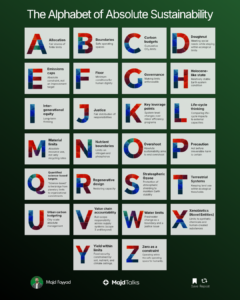
It starts with Allocation, the question of who gets what share of a finite budget. It depends on Boundaries, the safe operating spaces that science has identified across nine Earth-system processes. It requires Carbon budgets, the clearest example of a hard ceiling applied in practice. It is visualized through the Doughnut, the model that places human needs inside ecological limits. It is enforced through Emissions caps, the governance tools that turn limits into binding constraints. It requires a Floor, the social foundation that no sustainability agenda can sacrifice in pursuit of ecological targets. It depends on Governance, the rules and accountability structures that make limits real rather than aspirational. It protects the Holocene-like state, the relatively stable Earth-system conditions that made human civilization possible. It is grounded in Intergenerational equity, the obligation to leave future generations a planet that can support them. It cannot be achieved without Justice, which means acknowledging that the burden of staying within must not fall on those who contributed least to overshoot. It requires targeting Key leverage points, the rules and goals that change what systems optimize for rather than just tweaking parameters. It depends on Life-cycle thinking, because a claim that is locally clean but globally harmful is not a sustainability claim at all. It measures Material throughput, not just recycling rates. It respects Nutrient boundaries, the nitrogen and phosphorus cycles that agriculture has pushed dangerously out of balance. It aims to end Overshoot, the condition where human demand exceeds what ecosystems can regenerate. It applies Precaution when thresholds are uncertain and harm could be irreversible. It uses Quantified science-based targets to bridge planetary limits and organizational commitments. It aspires to Regenerative design, rebuilding ecological capacity rather than merely reducing harm. It draws on the success of Stratospheric ozone protection as proof that enforceable boundary governance can work. It protects Terrestrial systems, the living infrastructure of forests, wetlands and soils that regulate climate, water and biodiversity. It is being applied through Urban carbon budgeting in cities like Oslo that treat emissions like a line item in a financial plan. It demands Value chain accountability through Scope 3 reporting because you cannot stay within limits by outsourcing impacts. It sets Water limits because freshwater is not offsettable. It prices eXternalities and caps them rather than just naming them. It asks food systems to operate on Yield within limits, respecting soil health and nutrient cycles as bounded, not infinite. And it means Zero as in zero overshoot, not zero as a marketing claim but as a verified, measurable, binding commitment.
The question underneath everything
The Brundtland Report said sustainability implies limits. Decades of science have since shown us where those limits are and confirmed that several have already been crossed.
The question is no longer whether improvement is happening. It is whether improvement is enough to protect the planet.
Right now, in most cases, it is not.
And that leaves one question sitting underneath everything else. How much growth is actually compatible with a finite planet?