
If you have ever attended a sustainability conference in the GCC where net-zero buildings were on the agenda, you already know how the conversation usually ends. Someone, often a very experienced voice in the room, points out that net-zero buildings struggle to be cost-effective in this region, especially in a market where margins are already slim. The climate is harsh. Cooling loads are high. The economics are more challenging than they are in Europe or North America.
The room nods. The session moves on. And the assumption settles a little deeper into the regional mindset.
That conversation needs to shift.
Not because the climate concern is misplaced. The GCC is one of the most demanding environments in the world to build in. But that should lead us to a different conclusion. A harsh climate does not make net zero impossible. It makes the design choices that come before net zero matter more, not less.
If we want buildings in our region to be both cost-effective and capable of reaching net zero or nearly zero performance at the same time, we need to start with the part of the building that actually controls the load: the envelope.
We cannot afford not to consider passive design in our part of the world.
This is not new to the market. In 2017, I led one of the first regional studies on this topic for the Emirates Green Building Council. The study emphasised that any credible net-zero pathway in the UAE had to focus on aggressive passive measures first. Not because solar is unimportant, but because in a region where cooling dominates electricity demand, renewables alone cannot fix a building that was designed to need too much energy.
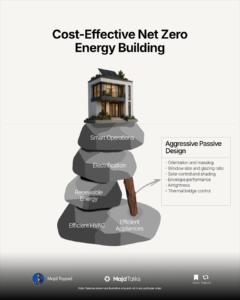
Aggressive passive design is not a philosophy. It is a different order of operations. It means optimising orientation, shading, solar control, glazing ratios, and envelope performance before HVAC and solar systems are sized.
In a hot climate, that sequence is not optional. If you do not fix the load first, your net-zero or nearly zero building is not cost-effective. You are left with an inefficient building and an oversized renewable system trying to compensate for avoidable demand. And when this happens, it does not only affect one project. It influences the market and reinforces the perception that net-zero buildings are not realistic for the region.
Why the Wrong Order Is an Expensive Order
Here is what typically happens on a building project in the region, especially in commercial projects. Architects make massing and orientation decisions early, often based on plot constraints and aesthetics, without modelling the thermal performance.. Glazing ratios are set for appearance. Then the mechanical engineer inherits a building envelope with high solar gain and poor thermal performance, and sizes the HVAC system to handle it. On top of that, HVAC system design is built on worst-case assumptions that lead to overdesigning the systems.
The result is a building that needs a large cooling plant and runs expensive HVAC throughout its life. If that same building is then expected to achieve net zero, it will require a substantial solar installation to compensate for demand that could have been reduced earlier. Every step in that sequence could have been cheaper. But the decisions that locked in the cost were made in the first stages of design, before energy performance became a serious part of the conversation.
Our 2017 study captured this market concern clearly. Eighty-six percent of industry stakeholders surveyed said a net-zero strategy in the UAE must be cost-effective. The buildings that targeted nearly zero or net-zero status had prioritised envelope performance, solar control, and orientation early, rather than relying mainly on the largest possible solar system.
That lesson has only become more relevant.
Where the Money Actually Goes
The cost argument for passive design is stronger than the market assumes. But you have to do the accounting correctly.
If you evaluate a high-performance envelope as a line item, in isolation, it looks expensive. If you evaluate it as a system, offset against the HVAC capacity it eliminates, the solar area it avoids, and operational savings, the picture changes significantly.
When loads are reduced through good envelope performance, orientation, external shading, and early daylighting, cooling peak loads fall. Smaller loads mean smaller chillers. Smaller chillers mean lower capital cost and simpler operations. And a building that needs less energy to run needs a smaller renewable system to reach net zero, fewer solar panels competing for limited roof and plot area.
The economics compound. Every unit of demand avoided also avoids capital expenditure in mechanical equipment and renewable generation. Annual utility savings accumulate over the building’s lifetime. And a building that runs on less energy is less exposed to future energy price volatility and upcoming carbon regulations.
Evidence from the U.S. market points in the same direction. Research cited by the National Renewable Energy Laboratory found that some zero-energy projects achieved only a 0% to 10% cost increase compared with conventional buildings when design, construction, systems, and operations were planned as one package rather than priced separately.
Take Discovery Elementary School in Virginia. By optimising massing, shading, envelope, and airtightness early, the team produced a building that operates at 66% lower energy use than the district average and saves the school district around $117,000 a year in utility costs, the equivalent of two teachers’ salaries. Jennings Creek Elementary in Kentucky came in $1.5 million below the state average for a school of its size while saving more than $195,000 a year in energy. The Bullitt Center in Seattle operates at an EUI of around 16 kBtu/ft²/year compared to a typical Seattle office at over 90, and achieves this performance while remaining financially competitive with comparable Class-A office buildings in its market.
Closer to home, the Masdar Institute campus in Abu Dhabi, inaugurated in 2010, was designed around a deliberate hierarchy of passive strategies before any active systems were sized. Self-shading facades, narrow streets that channel natural ventilation, deep overhangs, and a reinterpretation of traditional Arabic mashrabiya screens were used to drastically reduce solar gain. The result is a campus that uses 51% less electricity and 54% less potable water than a baseline UAE building of similar size and specification, and remains operational as a working research and academic facility more than a decade later. Masdar shows that passive-first design is not a Western luxury imported into the region. It is a regional approach with regional precedent.
The pattern is clear: when demand is reduced early, the systems that follow become smaller, cheaper to operate, and easier to justify.
What Aggressive Passive Design Actually Means in a Hot Climate
Aggressive passive design starts with one basic question: how much cooling demand can the building avoid before any active system is sized?
In the GCC, that starts with the early design decisions that control heat gain. Orientation, building form, window size, glazing ratio, envelope performance, airtightness, and thermal bridge control all affect how much heat the building must fight for the rest of its life. These are not secondary details. They decide whether the building begins with a manageable cooling load or carries avoidable demand from day one.
The 2017 EmiratesGBC study showed that Dubai’s external wall U-value requirement was roughly three times higher than the Passivhaus benchmark. That gap matters because weaker envelope performance turns directly into higher cooling load and higher operating cost.
Orientation and massing should also be treated as energy decisions from the concept stage. A form that reduces solar exposure, improves self-shading, and controls glazing can reduce cooling loads before chillers or PV panels are selected. These choices are often low-cost early in design. They become very difficult or impossible to change once the building is constructed.
Airtightness and thermal bridge control are just as important. Poor junctions, gaps, and uncontrolled infiltration can undermine the value of better insulation and glazing. These are not minor detailing issues. In hot climates, they decide whether the envelope performs as designed or keeps leaking performance for the life of the building.
The Correct Sequence Is the Strategy
For a cost-effective net-zero or nearly zero energy building in the MENA region, the order matters.
- Aggressively optimise orientation, massing, shading, glazing, and envelope performance early.
- Lock the passive design measures before HVAC systems are sized.
- Right-size mechanical equipment to the reduced cooling loads.
- Determine the renewable generation needed to close the remaining gap.
- Commission, measure, verify, and tune the building after operation begins.
That sequence changes both the technical outcome and the economics. It produces a building with a smaller cooling plant, lower operating costs, a more feasible renewable energy strategy, and stronger resilience in a climate where heat events are increasing.
What Needs to Change
The industry in the MENA region is capable of delivering net-zero buildings, or at least nearly zero-energy buildings, where limited roof space or plot space makes it difficult to install enough solar panels on-site. The technology exists. The climate does not make it impossible. What makes it harder than it needs to be is the way the market still treats passive design.
In our market specifically, three barriers stand out:
Split incentives. In many projects, the developer is focused on delivery cost, while the tenant or long-term owner carries the operating cost. That can make envelope upgrades look like an added expense, even when they reduce energy use and system size over the life of the building.
Low-bid procurement. When procurement focuses mainly on the lowest upfront price, details such as airtightness, shading quality, thermal breaks, and envelope continuity are often weakened. These details may look small in the tender process, but they have a long-term effect on cooling demand and operating cost.
Late value engineering. Passive measures are often removed late in the project to reduce capital cost. The problem is that these are the same measures that allow HVAC systems and renewable energy requirements to be reduced. When they are removed after systems are already sized, the project loses both the passive benefit and the cost-saving opportunity.
Policy is starting to evolve. The European Commission’s 2024 recast EPBD makes zero-emission buildings the standard for all new buildings from 2030. Saudi Vision 2030, the UAE Net Zero 2050 strategy, the building codes in Dubai and Abu Dhabi, as well as the cooling efficiency commitments from COP28, all move in the same direction. The framework is there. The question is whether this will be translated into actual projects on the ground, and where net-zero buildings can become mainstream and not just pilot projects.
To move the market forward, the next step should not be more discussion about whether net zero can work in the region. It should be a more serious focus on how to make it cost-effective.
That starts with building codes. More aggressive passive design measures need to be adopted and strengthened across the region, building on the progress already seen in cities like Dubai. Codes should push the market toward lower cooling demand before projects rely on mechanical systems and renewables.
It also requires stronger collaboration between developers, consultants, policymakers, contractors, and researchers. Net zero cannot move from pilot projects to mainstream adoption if each stakeholder treats performance as someone else’s responsibility.
The region also needs more studies on cost-effectiveness of net zero buildings. Markets such as the United States have built a stronger evidence base around the cost. The GCC needs similar research, using local climate, local construction costs, local energy prices, and local building typologies.
And because the climate is harsh, innovation in envelope design needs to be tested through real pilot projects. New facade systems, shading strategies, glazing solutions, and airtightness approaches should be proven under regional conditions, not only imported from other markets.
The Bottom Line
Net zero built on an inefficient foundation is fragile and expensive.
Aggressive passive design is not a constraint on ambition. It is the condition that makes ambition affordable in the MENA region.
Build the foundation first. Or watch the region keep paying for the misconception that net zero does not work here.