
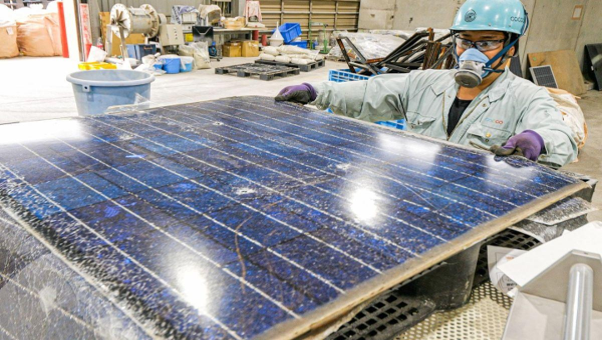
I see very few conversations about the end of life of solar panels and batteries when we talk about the clean energy transition.
That is understandable because we need clean power to meet our climate goals.
But what happens to these materials and equipment at the end of their life is equally important. We do not want to create another problem in the future that could be very complex to solve.
That is why my team and I started asking these questions:
- What happens at the end of life?
- What are the current practices?
- Should we reuse them, repair them, recycle them, export them, store them, or discard them?
This is not an argument against solar power or batteries. They remain the backbone of any serious plan to move away from fossil fuels. But if clean energy is meant to ease pressure on the planet, we also need to ask what happens to its materials and waste once the first life ends.
A technology should not only be evaluated by the benefits it provides or the problems it solves. It should also be evaluated by whether it respects all planetary boundaries.
That connects to the wider idea of absolute sustainability, where progress is not measured only by whether one solution is better than another, but by whether it can stay within real environmental limits over time.
How Much Waste Will Solar Panels and Batteries Leave Behind?
Solar panels usually last around 25 to 30 years. That is a long service life, but the first large waves of solar deployment are already aging. As the market grows, the end-of-life question grows with it.
A joint report from the International Renewable Energy Agency and the IEA Photovoltaic Power Systems Programme modeled global cumulative solar PV waste at about 0.1 to 0.85 million tonnes in 2020. By 2030, that could rise to 1.7 to 8 million tonnes. It could reach 15 to 32 million tonnes by 2040. By 2050, it could climb as high as 60 to 78 million tonnes, depending on whether panels retire at their expected age or leave service earlier because of damage, replacement, quality issues, or repowering.
A newer 2026 IRENA publication adds another way to look at the same issue. It estimates that the annual volume of end-of-life solar PV panels could exceed 3 million tonnes by 2035 and rise to more than 25 million tonnes by 2050. In other words, this is not only about total waste building up over time. It is also about the yearly flow of panels that cities, companies, recyclers, and regulators may need to handle.
Those numbers tell two stories at once.
The first is about waste. Millions of tonnes of old panels will need somewhere to go.
The second is about value. Those same panels contain glass, aluminium, silicon, copper, and silver that can still be useful. If companies and governments handle them well, these materials can return to the supply chain. If they do not, much of that value may be lost while adding more pressure to existing waste systems.
Batteries add another layer
Batteries raise a similar question, but with one important difference: not all batteries behave the same way at end of life.
Lead-acid batteries already have a mature recycling system in many markets. Lithium-ion battery recycling is moving from pilot projects into larger industrial operations, but their economics depend heavily on chemistry.
For example, batteries rich in nickel and cobalt often attract recyclers because the recovered materials have strong value. Lithium iron phosphate batteries are cheaper and safer in many uses, but recyclers may find them harder to monetize because the recovered materials are less valuable.
That detail matters.
End-of-life management is not one simple waste issue. It is a materials issue, a design issue, a policy issue, and a business model issue.
Why this issue still feels quiet
The end-of-life question is easy to overlook because it appears later.
A solar boom today does not create its largest waste challenge tomorrow. That challenge appears years later, once large numbers of panels and batteries reach retirement age. This delay makes the issue seem smaller or more distant than it is.
There is also a communication challenge. Solar panels and batteries are widely seen as symbols of climate progress, so discussing their waste can sometimes sound like criticism of clean energy itself. It should not.
A technology can be necessary while still needing better life-cycle planning.
The world does not need less clean energy. It needs a clean energy system that considers the whole journey, from materials to manufacturing, use, reuse, and recovery.
This is where the idea that recycling was never the answer on its own becomes relevant. Recycling enters the process too late if a product was never designed for repair, reuse, recovery, and safe collection from the beginning.
Better questions need to come earlier
For solar panels and batteries, the better questions should come before they reach the end of use:
- Can companies repair them?
- Can another user reuse them?
- Can recyclers collect them safely?
- Can valuable materials be recovered?
- Can producers continue to play a role after the product leaves the factory?
Those questions help decide whether clean energy follows the old pattern of extracting materials, making products, using them, and then struggling with disposal, or whether it becomes part of a circular system that reduces waste, extends product life, and transforms end-of-life materials into value.
The cost gap is still a major barrier
The ability to recycle solar panels already exists. The harder question is whether the economics work at scale.
In many markets, recycling remains more expensive than disposal. The U.S. Department of Energy’s PV End-of-Life Action Plan noted that PV recycling can cost around $15 to $45 per module, compared with roughly $1 to $5 per module for landfill. The same plan set a target to bring recycling costs down to about $150 per tonne, or around $3 per module, by 2030.
That gap explains why policy matters.
If landfill remains cheaper than responsible recovery, many markets will keep treating old panels as a disposal issue rather than a circular economy opportunity.
This is also why extended producer responsibility is important. When producers have clear financial and practical responsibility for takeback and treatment, end-of-life management becomes part of the business model, not something left for cities, waste companies, or future owners to solve later.
Some regions are already moving
Europe offers one of the clearest examples of policy trying to shape the market early.
Solar panels fall under the rules for waste electrical and electronic equipment. The European Commission’s WEEE framework requires separate collection and proper treatment of this waste, including photovoltaic panels.
Companies are also proving that better recycling can work in practice.
First Solar, one of the world’s largest solar panel manufacturers, has included recycling within its business model. The company says it can recover more than 90% of module materials for reuse, including materials that can return to new solar panels, glass, rubber, and aluminium products.
In France, ROSI Solar focuses on recovering higher-value materials such as silicon, silver, and copper from old photovoltaic panels. This matters because the future of solar recycling cannot depend only on recovering bulk glass and aluminium. The more valuable materials also need a pathway back into the economy.
Second-life batteries help, but only partly
Batteries are more complex because the end of first life is not always a clear stopping point.
An electric vehicle battery that no longer provides the driving range expected by its owner may still hold enough capacity for another purpose. It may no longer be the best fit for a vehicle, but it could still store energy for a home, business, or electricity system, where weight and size matter less.
That is why second-life batteries are part of the answer.
In California, B2U Storage Solutions has used second-life electric vehicle batteries from Honda and Nissan to build solar energy storage. Its Sierra facility reached 25 MWh of storage capacity using more than 1,000 used batteries.
The idea is straightforward: use the capacity that remains before recycling becomes the final step.
Even so, second-life use cannot carry the whole burden.
The International Energy Agency estimates that reused EV batteries may meet only around 10% of global storage demand by 2050. So second-life use matters, but high-quality recycling still needs to grow.
Battery recycling is also a supply question
Recycling batteries is not only about reducing waste. It can also reduce pressure on new mining, improve supply security, and keep valuable materials in circulation for longer.
The IEA’s Recycling of Critical Minerals report estimates that recycled battery materials such as lithium, nickel, and cobalt could meet 20% to 30% of demand by 2050 if collection rates improve. It also notes that recycled nickel, cobalt, and lithium can have around 80% lower greenhouse gas emissions than primary supply from mining and refining.
This is where the opportunity becomes much bigger than waste management.
You cannot tell much about a used battery just by how it appears because its chemistry, condition, safety record, remaining capacity, and history all matter. Without that information, reuse and recycling become harder.
That is why traceability is becoming part of circularity.
The European Commission says battery passports will become mandatory for relevant battery categories placed on the EU market from 18 February 2027. A battery passport is a digital record that can include information about a battery’s materials, origin, technical characteristics, performance, durability, repair, reuse, recycling, and sustainability profile.
If clean energy products are going to become part of a circular system, there needs to be a clear record of what they contain, where their materials came from, and what condition they are in after use.
Countries are choosing different pathways
The policy picture is becoming clearer, but it is not moving the same way everywhere.
The European Union is building one of the most developed legal frameworks for batteries and solar waste. It is using collection rules, recycling targets, and digital passports to make circularity part of the system rather than a voluntary add-on.
India has also taken a stronger position on batteries. Under its Battery Waste Management Rules, 2022, producers are responsible for collecting, recycling, or refurbishing waste batteries. The rules also prohibit collected waste batteries from going to landfill or incineration.
Australia is moving toward a national solar panel recycling pathway. The government has announced a $24.7 million national solar panel recycling pilot, designed to collect data, test collection and recycling models, and support a future product stewardship scheme.
What this means for your city
This is where the issue becomes practical for city governments, utilities, and the communities they serve.
If your city is installing solar on public buildings, expanding EV charging and bus fleets, or building out battery storage for the grid, it also needs to plan for what happens to those assets once they wear out.
- Who takes back the panels when they are removed from municipal buildings?
- Does the city have access to certified recyclers, or will old panels end up in general waste?
- Can retired batteries from public transit fleets be tested for a second life before recycling?
- Are recycling and take-back requirements built into public procurement and tenders?
These are not side questions. They shape whether a city’s clean energy investment holds up over its full life cycle, not just at the ribbon-cutting.
This also means cities may need more than recycling access. They may need better data, trained waste handlers, supplier accountability, local collection systems, and public procurement rules that support reuse and recycling from the start.
A city may reduce its emissions today by going solar or electrifying its bus fleet, but it still has to manage the material story behind those assets years down the line. For many municipalities, that will require closer coordination between procurement offices, waste management departments, and sustainability teams, along with local regulations that account for panels and batteries at end of life, not only at installation.
The next stage of clean energy planning will not only belong to engineers. It will also involve procurement officers, public works departments, sustainability leaders, and city councils deciding what responsible ownership looks like after installation.
Better answers are already taking shape
Some companies are already working in that direction.
Redwood Materials recovers critical materials from lithium-ion batteries and returns them to the supply chain. The company says that it can recover, on average, more than 95% of materials such as lithium, nickel, cobalt, copper, aluminium, and graphite.
This does not answer every challenge. Battery recycling still needs reliable collection systems, safe transportation, workable economics, and enough processing capacity to support future demand.
But it shows that more circular approaches are no longer just theory.
The next phase of clean energy is circular
The clean energy transition remains essential.
Solar panels and batteries will continue to play an important role in climate action. But their success should not only be measured by how many are installed. It should also be measured by what happens when they are removed, wear out, or are replaced.
That means planning for the end from the beginning by:
- Reducing waste through better design, longer product life, and easier repair
- Reusing panels and batteries where testing, safety, and performance allow it
- Recycling valuable materials through safe and certified processes
- Building collection systems before waste volumes increase
- Using policy and procurement to make takeback and recovery part of the system
Solar panels and batteries are already part of the climate solution. The real question is whether the world builds the systems to manage them responsibly once their first life ends and whether policy, markets, and infrastructure can move fast enough to keep up.