
You have probably come across discussions about sustainable diets. Some focus on organic food. Others talk more about eating less meat and dairy, or cutting animal products out completely.
Those choices do matter. And the truth is, there is no single way to define sustainable eating. The environmental impact of food depends on several things at once, including greenhouse gas emissions, land use, water use, eutrophication, biodiversity impact, transport, packaging, food waste, and more. And these factors do not always point in the same direction.
For example, one food may produce fewer emissions but require more water. Another may be organic but take up more land. A local food can also have a bigger environmental impact than something imported.
According to Our World in Data’s research on the environmental impacts of food, food production accounts for about 26% of global greenhouse gas emissions. It also uses around half of the world’s habitable land, 70% of global freshwater withdrawals, and contributes to 78% of global ocean and freshwater eutrophication.
So yes, food choices matter. But they do not matter in just one way.
That is why this article looks at sustainable eating through ten practical questions, not one fixed rule.
1. Is vegan food automatically the most environmentally friendly?
Plant-based diets often have a lower environmental footprint than diets that are heavy in animal products. That is one of the clearer findings in the research. A major University of Oxford study on diet and environmental impact found that vegan diets had about 30% of the environmental impact of high-meat diets across greenhouse gas emissions, land use, water use, water pollution, and biodiversity pressure.
But that does not mean every vegan food is automatically sustainable.
That is the point I explored in this video on veganism and the environment. Plant-based eating can reduce emissions and land use, but the details still matter. Almonds can be water-intensive. Avocados can put pressure on water supplies in some regions. Some highly processed plant-based foods may also come with more packaging, more energy use, or longer supply chains.
So yes, choosing more plant-based meals can be one of the better environmental shifts. But not all vegan foods are equal. Because sustainability depends on several factors such as production methods, sourcing, transportation, and overall resource use.
2. What actually determines a food’s environmental footprint?
A food’s environmental footprint is not decided by one thing.
Carbon matters, but it is only part of the picture. You also have to look at land use, water use, fertilizer runoff, biodiversity impact, transport, packaging, storage, and how much of that food ends up wasted.
That is why sustainable eating can get tricky. A food may have low emissions but use a lot of water. Another may be grown locally, but still requires large amounts of land or energy. A product may come in eco-friendly packaging, but the bigger impact may have happened much earlier, on the farm.
This is why Our World in Data’s research on the environmental impacts of food is useful. It shows food across different measures, not just carbon.
The better question is not just, “Is this food sustainable?” It is, “What kind of impact does this food create, and where does that impact come from?”
3. Why do beef and lamb usually have the highest emissions?
Beef and lamb often have a much higher footprint than most other foods because of how ruminant animals digest food.
Cows and sheep produce methane during digestion. That matters because methane is a powerful greenhouse gas. These animals also need land, either for grazing or for growing feed. In some places, that land pressure can also contribute to deforestation and biodiversity loss.
This does not mean every farm is the same. Some farms manage grazing better than others. Some systems may support soil health or use land that is not suitable for crops. So the point is not to reduce the whole topic to “beef is bad.”
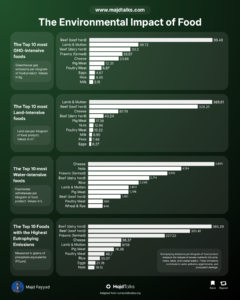
But the data is still clear that beef and lamb are usually among the highest-impact foods. Our World in Data’s food emissions comparison shows that what we eat often matters more than how far food travels, especially when comparing high-impact meats with most plant-based foods.
So if someone wants to reduce the footprint of their diet, eating less beef and lamb is often one practical place to start.
4. Are local foods always better?
Local food can be a good choice. It can support nearby farmers, reduce some supply-chain pressure, and help people eat more seasonally. There is also something practical about knowing where your food came from.
But local does not always mean lower impact.
For most foods, transport is not the biggest part of the footprint. Our World in Data’s analysis of food miles shows that transport accounts for less than 10% of emissions for most food products, while what happens on the farm usually matters far more than how far the food travels. A widely cited study on food miles and climate impact reached a similar point: production choices often matter more than transport distance.
This is why a local beef steak can still have a much higher carbon footprint than imported lentils or beans. Distance is only one part of the story.
But this does not mean local food is unimportant. If we are comparing the same type of food, then eating locally often makes sense. Local tomatoes, local grains, or local vegetables can reduce transport needs, support local producers, and improve freshness. The point is not to discourage local eating. The point is to show that eating locally alone does not mean we have fully addressed the environmental footprint of food.
There are exceptions, of course. Air-freighted foods can carry a much higher transport footprint, especially when they are fresh, delicate, and flown long distances. But for most everyday foods, the first question is what type of food it is. The second is how it was produced. The third is where it came from.
5. Is organic always more sustainable?
Organic food can be better in some ways, but it is not automatically the most sustainable option.
Organic farming usually avoids synthetic fertilizers, synthetic pesticides, and GMOs. That can reduce chemical pollution and support soil health in some farming systems. The Food and Agriculture Organization’s overview of organic agriculture also notes that organic systems often focus on soil fertility, pest management, and longer-term farm health.
But sustainability is wider than production rules.
This is the point I explored in this video on why organic and sustainable are not the same thing. Organic tells us something important about how food is grown, but it does not automatically tell us whether that food has low emissions, low water use, or efficient land use.
Yield is one reason this gets complicated. A Nature study comparing organic and conventional crop yields found that organic yields are often lower than conventional yields, although the gap depends on the crop, location, and farming method.
Organic can be part of a sustainable food system. It just should not be treated as a shortcut for sustainability.
6. Can plant-based foods still have major environmental impacts?
Yes, they can.
This is where the conversation needs a bit more honesty. Plant-based foods usually have a lower footprint than animal products, but that does not mean every plant-based food is automatically low-impact.
Some plant-based foods can put pressure on the environment when they are grown in dry regions or places already facing water stress. Almonds, avocados, and some nuts often come up in this discussion. Their impact depends heavily on where they are grown, how much irrigation they need, and whether local water systems can handle that demand.
Critics of plant-based diets sometimes use examples like soy, almonds, or avocados to argue that plant-based eating is not really better for the environment. But that can miss the bigger picture.
Take soy, for example. It often gets blamed in conversations about vegan diets and deforestation. But Our World in Data’s soybean production data shows that most soy is not eaten directly by humans. A large share is used for animal feed, biofuels, and processed products. So, blaming tofu or soy milk for the whole soy problem can be misleading.
7. How important is food waste in the sustainability conversation?
Food waste deserves a much bigger place in the sustainable food conversation. Most discussions about sustainable eating focus on the type of food people choose. Is it vegan? Is it vegetarian? Is it organic? Is it local? Those questions matter, but they are not enough. Food waste is often treated as a separate waste-management issue when it should be part of how we talk about food sustainability from the start.
The UNEP Food Waste Index Report 2024 found that 1.05 billion tonnes of food were wasted in 2022 across households, food service, and retail. That was about 19% of food available to consumers, with households responsible for the largest share.
That matters because wasted food carries the footprint of everything that came before it. The land was used. The water was used. The fertilizer was applied. The food was harvested, stored, transported, cooled, packaged, and sold. Then it ended up in the bin.
This is also one of the comparisons I raised in this video on veganism and sustainability. We cannot talk seriously about sustainable diets while ignoring the amount of food being wasted, especially at a time when the UN’s 2024 food security report shows that hundreds of millions of people still face hunger.
So yes, choosing better food matters. But using the food we already produce matters too.
8. How much does packaging matter?
Packaging matters but isn’t always the biggest part of a food’s environmental footprint.
It’s quite simple to concentrate on packaging since it’s evident. You actually see the plastic wrapper, the carton, the bottle or the takeaway container. But for many foods, the bigger environmental impact occurs before, in farming, land use, irrigation, fertilizer use, processing or refrigeration.
That does not mean packaging should be ignored. Poor packaging choices can increase plastic waste, add unnecessary materials, and make recycling harder. In some cases, packaging can also extend shelf life and reduce food waste, so the trade-off is not always obvious.
This is why packaging needs to be judged in context. A food with less packaging is not automatically more sustainable if it spoils faster and gets thrown away. And a packaged food is not automatically worse if the packaging helps protect the product and reduce waste.
The better question is not simply, “Does this food have packaging?” It is, “Was the packaging necessary, is it designed responsibly, and does it help reduce waste or create more of it?”
9. What trade-offs exist between sustainability, nutrition, affordability, and culture?
This is where sustainable eating needs to stay human.
A food choice can look good on an emissions chart and still be unrealistic for many people. Maybe it is too expensive. Maybe it is not available locally. Maybe it does not meet someone’s nutritional needs. Or maybe it ignores food traditions that matter deeply to a community.
That does not mean sustainability should be pushed aside. It means the conversation has to be grounded in real life.
The FAO and WHO’s work on sustainable healthy diets makes this point clearly. A sustainable diet is not only about the environment. It also has to consider health, affordability, accessibility, culture, and local context.
That is why one-size-fits-all solution often falls short. Telling everyone to eat the same way ignores income, geography, health needs, religion, tradition, and food access.
A better approach is to ask: what is the most sustainable improvement that actually works for this person, this household, and this community?
10. What are the biggest misconceptions about sustainable eating?
The biggest misconception is that one rule can solve everything.
Vegan food is often lower-impact, but not every vegan product is automatically sustainable. Organic food can offer real benefits, but organic does not always mean lower carbon, lower water use, or better land efficiency. Local food can support local farmers, but it is not the only factor that determines footprint. Packaging matters too, but it should be considered alongside food waste, production methods, transport, and resource use.
And individual choices matter, but they are only one part of the system. Food sustainability is also shaped by farming practices, subsidies, supply chains, retailers, waste systems, pricing, and public policy.
That is why the better way forward is not to turn food into a moral scoreboard. It is to make better choices with better information.
Eat more plant-forward meals when possible. Reduce high-impact foods if they are a regular part of your diet, especially beef and lamb. Waste less. Pay attention to water and land, not just carbon. Think about how food is produced, not just what label it carries. And leave room for nutrition, affordability, and culture.
Sustainable eating is not about finding one perfect diet or following one perfect rule. It is about understanding the system behind the food: how it was grown, how much land and water it used, how far it travelled, how much was wasted, and what it replaced on the plate.
The more honestly we look at those trade-offs, the better our choices become. Not perfect choices. Better ones that fit the real world.